
Lifting over 10 tons in one shift – easy thanks to the coboworx palletizing solution.
Alexandra Harin
Company
Lay Gewürze
Industry
Food and Beverages
Company Size
135 employees
Application
Automation solution for palletizing buckets
At a glance
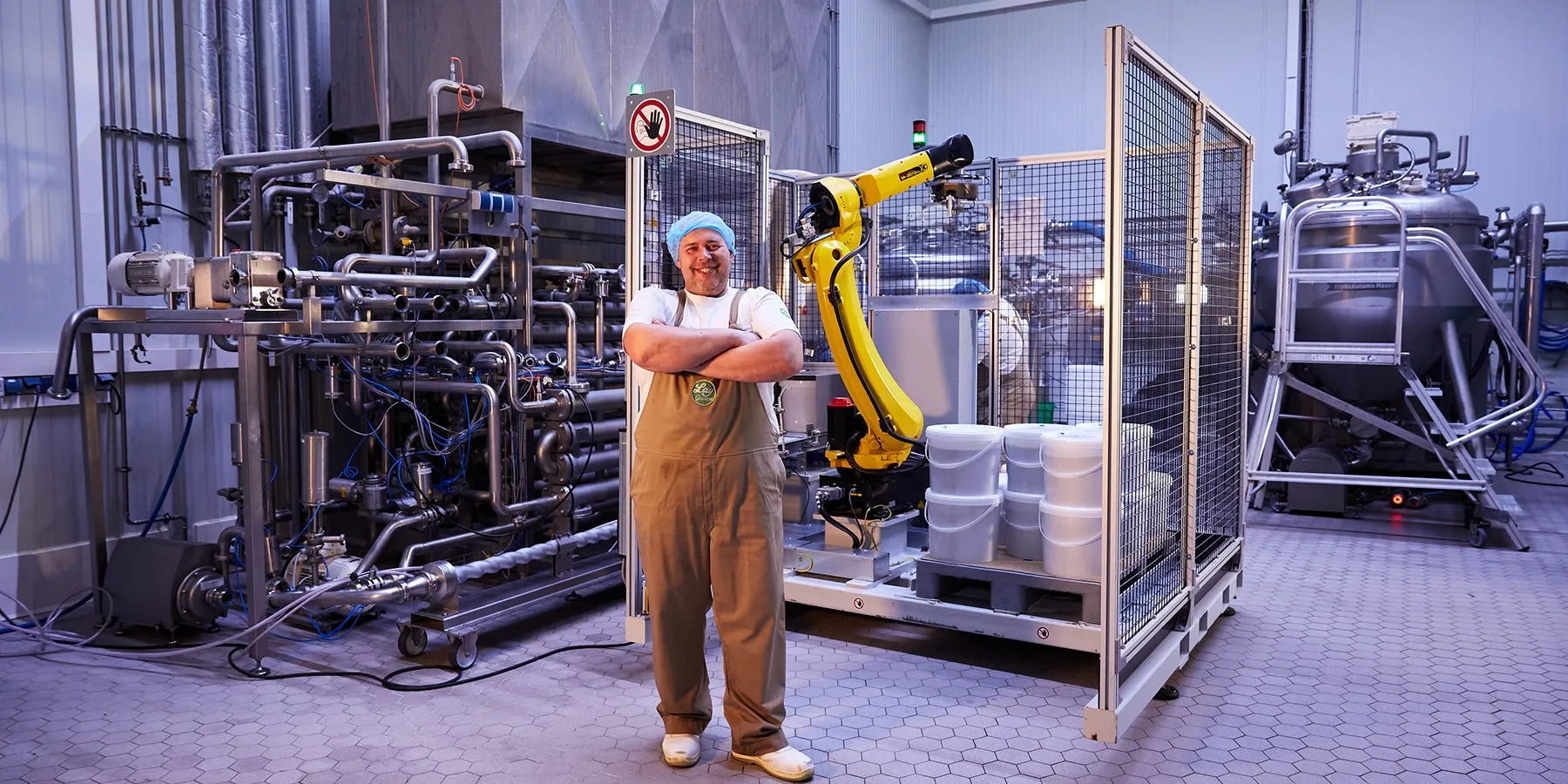
Lay Gewürze, a family-owned company based in southern Thuringia, produces spices and spice blends for the craft industry and the general food industry. Its wide range of dry, liquid, and paste-like spice blends is used to enhance various foods. Over 2,000 tons of raw and finished goods are stored in oxygen-reduced warehouses and processed in the company's own spice mills. Lay Gewürze produces exclusively for B2B, which is why containers of up to 25 kilograms are filled. In the case of the automation solution that Lay Gewürze implemented together with coboworx, the containers filled are buckets with a weight of 15.9 kilograms. In the past, these had to be stacked manually on pallets by employees. With a throughput of approximately one ton per hour, this meant that around 8 tons were palletized by hand in an 8-hour shift. Thanks to the automation solution for palletizing, effective added value was created for the employees, which was clearly noticeable from the moment it went into operation.
The Challenge
Of a total of 135 employees, approximately 70 work in production, working in two or three shifts as required. “The challenge in recent years has been to find suitable employees for production who are willing to support the increasingly complex processes and undergo training in accordance with the hygiene requirements of the food industry,” reports Michael Fischer. As operations manager at Lay Gewürze, he is responsible for technology in general and for production in the human resources department. The second major problem was the high physical strain on employees due to the fact that relatively heavy containers are filled in the B2B sector. “Hoisting 8-10 tons manually onto pallets every day – no one can do that for long, and we didn't want to put our employees through that,” says Michael Fischer. That was one of the main reasons why Lay Gewürze opted for the automation solution: primarily to create effective added value for employees and to reduce their physical strain.
The Solution
In May 2022, Michael Fischer began to take a closer look at automation and came across coboworx and the coboworx online configurator while researching online. He entered the relevant data into the configurator and received a response within a few days. “In principle, it took about half a year from the start of the project in mid-May 2022 to commissioning,” recalls Michael Fischer. Commissioning took place during live operation and was “one of the shortest machine commissioning processes” he had ever experienced, reports the plant manager. "We basically produced buckets, placed a pallet next to us so we could continue palletizing by hand, and then added the robot so we could ‘feed’ it at the same time. After the first half pallet of manual palletizing, we stopped and let the robot do the work. It was a very pleasant commissioning because we had already discussed relatively intensively in advance how we should implement the solution."
“I had looked at the production schedule and said: If so, then we'll also do the commissioning while we're producing. It was one of the shortest machine commissioning processes I've ever experienced.”
The coboworx palletizing solution is very easy to use. There are two different weight modes that can be selected using a toggle switch: 3.5 kg and 15.9 kg. Once the pallet is full, an employee uses a forklift to remove it, confirm receipt, and drive it away, while the robot continues palletizing almost seamlessly on the newly placed, empty pallet.
The automation solution is mobile and can be moved using a forklift. When the robot is not in use, it can be moved to the side to free up space for other tasks. Michael Fischer is very satisfied with the space situation, because Lay Gewürze is now running out of room. The robot cell can be moved in just a few simple steps: disconnect the compressed air and high-voltage power, drive the forklift truck under the cell, and move it. Since Lay Gewürze palletizes two different products with the system, the gripper can be converted just as quickly and precisely when changing products: see video.
Robotic system process & gripper modification during product changeover
Key features of the “Basic Move” palletizing solution
- Fanuc industrial robot M-20iD/25 with a payload of up to 25 kg
- Stable gripping of workpieces with suitable gripping technology
- Space requirement 6 m² (3x2m)
- Integrated safety fence with a signal light, accessible from one side
- Integrated area monitoring
- Easy to use without expert knowledge
- Mobile, can be moved with a forklift
- Setup and commissioning in just one day
- Safety concept and CE certification included
Success - Facts at a glance
6 m2
Space Requirement
15,9 kg
Weight of Workpieces
20 %
Increase in Throughput
starting at 2.600, - € / mth.
Rental rate “Robot subscription”
Michael Fischer got the employees on board right from the start and communicated transparently to them that physical relief was the main concern and that palletizing buckets should therefore be automated. The employees therefore responded very positively to the robot. “They immediately christened it Harry. That was the name of a long-time employee who has now retired,” laughs Michael Fischer. Another effect was an approximately 20 percent increase in efficiency that was achieved in production. Previously, one ton was palletized in about 60 minutes, but with the automation solution, it takes about 45-50 minutes.
Since it was our first automation solution, we agreed on a three-month trial period with coboworx: Lay Gewürze purchased the tool from coboworx, and coboworx provided the robot. During the three months, we were able to thoroughly test how the robot solution works in our process, and it works very well. We are very satisfied!

Michael Fischer, Operations Manager, Lay Gewürze
Since it was our first automation solution, we agreed on a three-month trial period with coboworx: Lay Gewürze purchased the tool from coboworx, and coboworx provided the robot. During the three months, we were able to thoroughly test how the robot solution works in our process, and it works very well. We are very satisfied!
Michael Fischer, Operations Manager, Lay Gewürze
Since it was our first automation solution, we agreed on a three-month trial period with coboworx: Lay Gewürze purchased the tool from coboworx, and coboworx provided the robot. During the three months, we were able to thoroughly test how the robot solution works in our process, and it works very well. We are very satisfied!
Michael Fischer, Operations Manager, Lay Gewürze
Configure your palletizing solution now and receive a customized price quote within 48 hours.
Use CasePalettizingRobot for Rent

Alexandra Harin
Senior Content Marketing Managerin
You may also be interested in these articles:

Newsletter
Stay up to date with industry updates, new solutions, free webinars, and other topics. But don’t worry—you can unsubscribe from our newsletter at any time.